
Discover the Wabanaki-Acadian Forest with Thriving Forests
Spotlight on the Eastern White Pine – Pinus strobus – guow
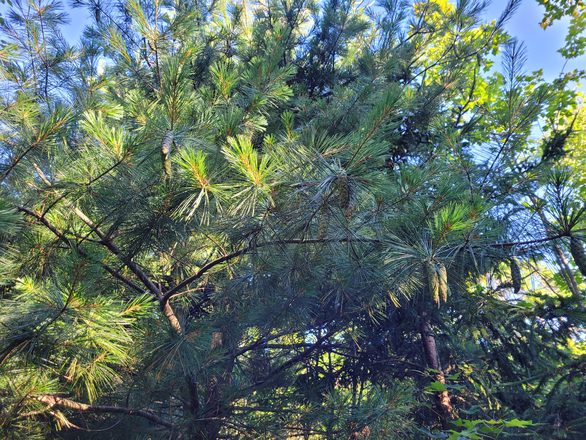
Through Thriving Forests, a program dedicated to understanding the ecological importance of Nova Scotia’s Wabanaki-Acadian Forest, we’re shining a spotlight on the Eastern white pine this month.
Uses of Eastern white pines
Eastern white pines are commonly chosen as Christmas trees, and their branches are used in wreath making. When grown in full sun, they have a bushy appearance that requires pruning to achieve the traditional Christmas tree shape.
The wood from white pine is relatively knot free and is often used for window and door trim in houses. While it is less favored for flooring and furniture due to its softness and tendency to cup, in the past it was used for flooring, timber framing and ship masts.
Identifying Eastern white pine
Eastern white pine is one of the largest trees in eastern North America, reaching heights up to 30 metres with trunks up to 100 cm in diameter. Some specimens have thrived for as long as 450 years, surpassing the growth of surrounding forest. Their size makes them ideal nesting sites for large birds like bald eagles.
White pine trees are easily identifiable as the only native pine tree with needles arranged in bundles of five. Red and jack pines, which are also native, have needles form in bundles of two. Among our native coniferous species, white pine is expected to fare best amidst climate changes, making it an ideal species to plant for our program.
Identifying Eastern white pine seeds
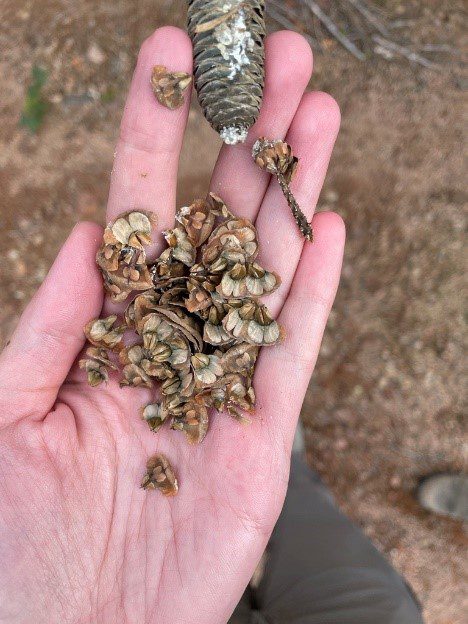
Eastern white pine produces slender seeds within cones. These cones, which hang from branches in clusters, are 8-20 cm in length. Mature cones transition from greenish-yellow to a golden or light brown hue when ripe.
The cones consist of 50-80 tightly overlapping scales in rows, enclosing seeds beneath each scale. As the cones begin to open and reach ripeness, the seeds are released on a wing, measuring 20 mm in length. These seeds have a flecked brown seed coat, measuring 5-7 mm in length.

How to harvest seeds
When collecting cones, cut one in half to inspect the interior where the seeds are located. A healthy cone will contain 8-12 viable seeds visible in its half section. It is important to perform a seed count via cut test to gauge the quantity of healthy seeds per cone. Healthy seeds have a firm, white-yellow embryo that fills the seed cavity.
Additionally, make sure you have permission to gather seeds from the area you’re visiting and create an identification tag with information about the species, tree location, GPS coordinates and date.
To join our network of tree monitors or if you know a stand of trees in your community that you would like to direct us to, please reach out via thrivingforests@cleanfoundation.ca.
If you are interested in learning more about Thriving Forests program, click below.

Warmth and energy efficiency on the edge of the sea
The Clean Energy Financing program helps a family on Long Island upgrade their home’s efficiency, feel warmer, and save money – while paying for the retrofits at a pace they can afford.Sipping tea while looking out the living room window of her 200-year-old house, a...

Meet the Tanner Family
Meet the Tanner Family. Like so many of us, heating their house took a big chunk out of the monthly budget. Improving the energy efficiency of their home would help, but the upfront costs can be a challenge. Fortunately, they qualified for HomeWarming, and it’s made a...
Work-Integrated Learning: A Key Piece to Growing Canada’s Green Economy
As Canada actively works towards transitioning to a low carbon economy, job opportunities within the environmental and clean technology sector are growing rapidly. This, combined with our aging workforce, creates an opportune time for graduates to explore and pursue a...
Recent Comments